Karma’s one-off Eximius 1 pairs a 6.2-liter V8 with electric motors for about 1,200 hp, with deliveries scheduled for 2027.
A client-built track car
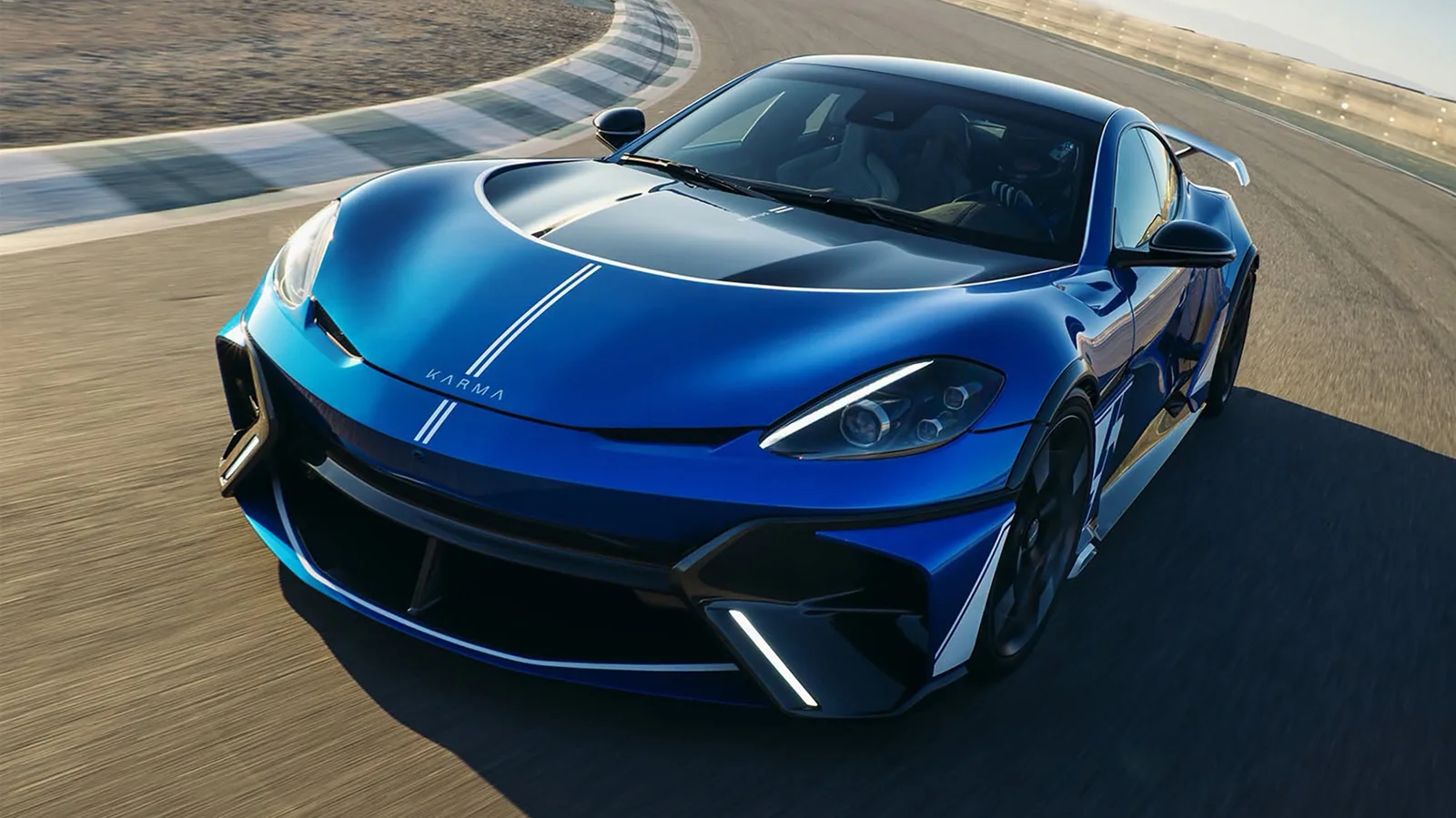
Karma’s Eximius 1 takes the company’s familiar four-seat GT formula toward track use, pairing extensive chassis and body changes with a plug-in hybrid system rated at about 1,200 hp. The project is the first of nine bespoke cars Karma plans to create for individual clients, and this one-off is due for delivery in 2027. That makes it both a personal commission and an early signal of how far the company is willing to push its existing platform.
The Eximius 1 builds on the Gyesera, which succeeded the Revero and traces its roots to the original Fisker Karma. It retains the donor car’s greenhouse, roofline, lights, and doors, while replacing much of the rest of the bodywork. That approach gives Karma a recognizable starting point while letting it change the car’s stance and purpose without presenting the result as an entirely new vehicle.
There’s a practical reason to keep the familiar upper body: the greenhouse and doors define much of a car’s proportions and identity. The extensive lower-body revisions, meanwhile, suggest that the brief called for a more assertive visual presence and track-oriented hardware. The source material doesn’t specify how much of the altered bodywork is functional, so the fins, diffuser, and spoiler should be read as design features with aerodynamic intent, rather than as proof of a particular performance gain.
Carbon fiber, track cues, and four seats
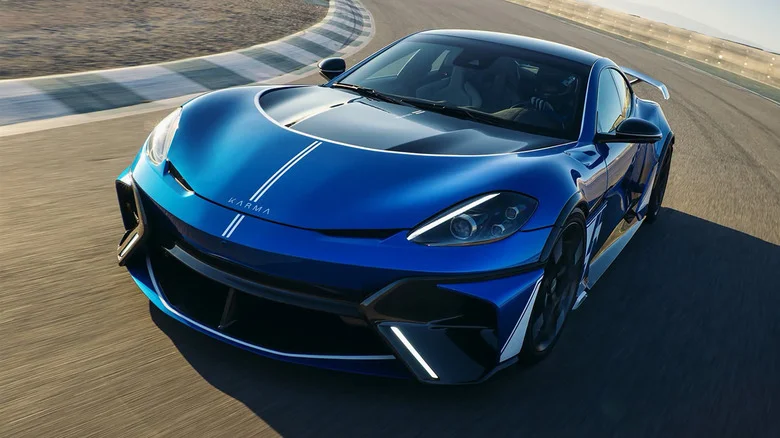
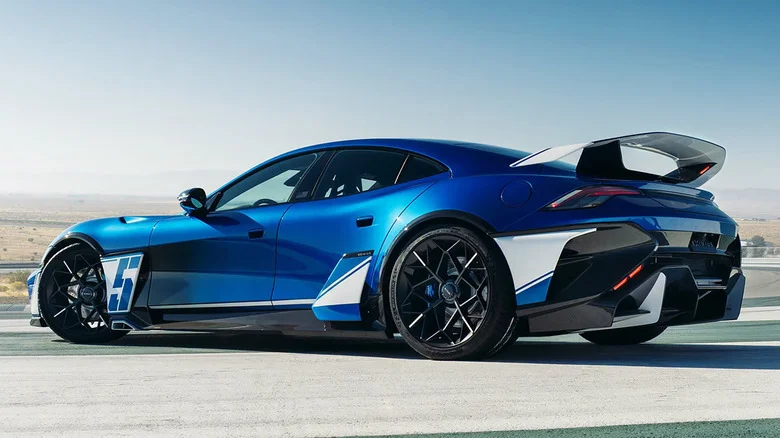
Its Borealis Blue finish is set off by white graphics and exposed carbon fiber. The kit adds reshaped bumpers, diagonal daytime running lights, a vented hood, carbon fiber fender extensions, wider side skirts with aerodynamic fins, a large diffuser, and a fixed rear spoiler. Taken together, those changes give the car the visual language of a track-focused machine, while the retained four-seat layout keeps it tied to the GT format that defines its donor.
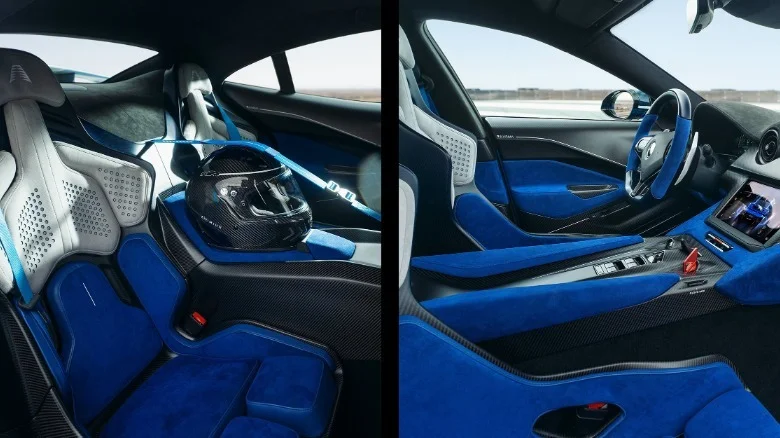
Inside, four Recaro bucket seats are trimmed in Borealis Blue and Moondust Alcantara, with carbon fiber throughout. A motorsport-style kill switch sits on the center console, and a custom carbon racing helmet is mounted between the rear seats. The helmet is a striking detail, but it also underlines the commission’s showpiece character: this is a client-specific object, shaped to communicate an idea of track use as much as to describe the car’s everyday role.
That distinction matters. Four seats give the Eximius 1 a different proposition from a purpose-built two-seat track car, but the source doesn’t say how usable the rear seats are or whether the car has been developed for regular circuit sessions. If you’re working in this space, the question is less whether the styling looks serious and more how the added power, wider tracks, and bespoke components behave together under sustained use.
A 1,200 hp plug-in hybrid powertrain
The headline hardware is a series plug-in hybrid system built around a 6.2-liter V8. Karma hasn’t named the engine’s supplier; the source article suggests it may come from General Motors. The company attributes 550 hp to the combustion engine and 650 hp to the electric motors, for a combined output of around 1,200 hp. Those figures describe a substantial jump in ambition for a platform whose recent direction has centered on a much lower combined output.
In a series hybrid arrangement, the engine and electric motors serve different roles from those in a conventional setup, though the source doesn’t provide further details about the Eximius 1’s operating modes, battery capacity, or electric-only range. That leaves important questions unanswered about how the powertrain manages heat, energy, and repeated high-load driving. Big output figures are easy to headline. How a plug-in hybrid sustains that performance on a circuit is the more demanding test.
Karma quotes a 0–60 mph time of 2.7 seconds and a top speed above 200 mph. Those are striking claims for a four-seat plug-in hybrid, but they’re manufacturer figures, and the source doesn’t say what conditions or testing method underpin them. The Eximius 1 also sits well beyond the Gyesera’s recently announced range-extender setup, which produces a combined 566 hp. That comparison makes the new car’s position clear: Karma is using this commission to explore a far more extreme performance brief.
Chassis, suspension, and braking
The car is presumed to use the aluminum spaceframe chassis developed during the Fisker era. Karma has added Öhlins semi-active suspension, wider tracks, and carbon-ceramic brakes with two-piece slotted rotors. The brakes sit behind 21-inch magnesium wheels. That collection of hardware points to a chassis package intended to handle more demanding driving than the standard donor car, even though the source provides no weight, tire, or lap-time details.
Each part also has to work with the others. Wider tracks can alter a car’s stability and cornering behavior; suspension and brake upgrades then have to account for the revised setup and the power the car can deliver. The source doesn’t explain the engineering changes in detail, so it’s too early to judge how much the Eximius 1 has been tuned for repeatable track performance. Still, the combination of semi-active suspension and carbon-ceramic brakes is more meaningful than a body kit alone.
A one-off with a broader question
Marques McCammon, Karma Automotive’s president and CEO, said the project began with an existing Revero owner who wanted “something more extreme and unexpected.” He described the Eximius 1 as the most powerful plug-in hybrid ever developed. Karma hasn’t disclosed a price, but the extent of the custom work points to a substantial price tag. The company says this particular car won’t be repeated.
That last point sets a limit on what the car can prove. A one-off can demonstrate a company’s willingness to customize an existing platform, and it can showcase parts and engineering choices that might inform future work. It can’t, by itself, establish that the same approach can be produced at scale, supported over time, or offered to a wider group of buyers. And this is the part most people overlook: a bespoke car’s significance may rest as much on what the company learns from building it as on what the owner receives.
This is more significant than it looks, though the evidence is still narrow. Karma’s plan for nine bespoke cars suggests the Eximius 1 belongs to a larger client-led effort, but the source gives no details about the other commissions or whether they’ll share its powertrain and chassis changes. The company has made a clear statement about performance ambition; it hasn’t yet shown whether that ambition will extend beyond individual projects.
What the Eximius 1 could signal
For now, the Eximius 1’s significance will come down to whether Karma can turn this client-led engineering exercise into a broader expression of its performance ambitions. The 2027 delivery will put a single, four-seat, 1,200 hp hybrid on track, giving the company a concrete showcase for its work. Whether that showcase points toward future products or remains a singular commission is an open question.
That said, the project gives Karma a way to test how far its familiar GT formula can stretch: from a car with roots in an earlier Fisker model to a bespoke hybrid with track-focused hardware. What this means for you as a reader is straightforward: the Eximius 1 is a revealing statement of intent, but its specifications and one-off status leave the bigger business case unproven. For now, a very powerful client car. The next step is evidence of what the company can carry forward.
 Karma Automotive
 Karma Automotive


Discussion
Sign in to join the discussion.