Nismo Nick reworks the R51 Pathfinder into two SEMA builds: a 501 hp manual Trackfinder and a lifted, V8-powered Trailfinder.
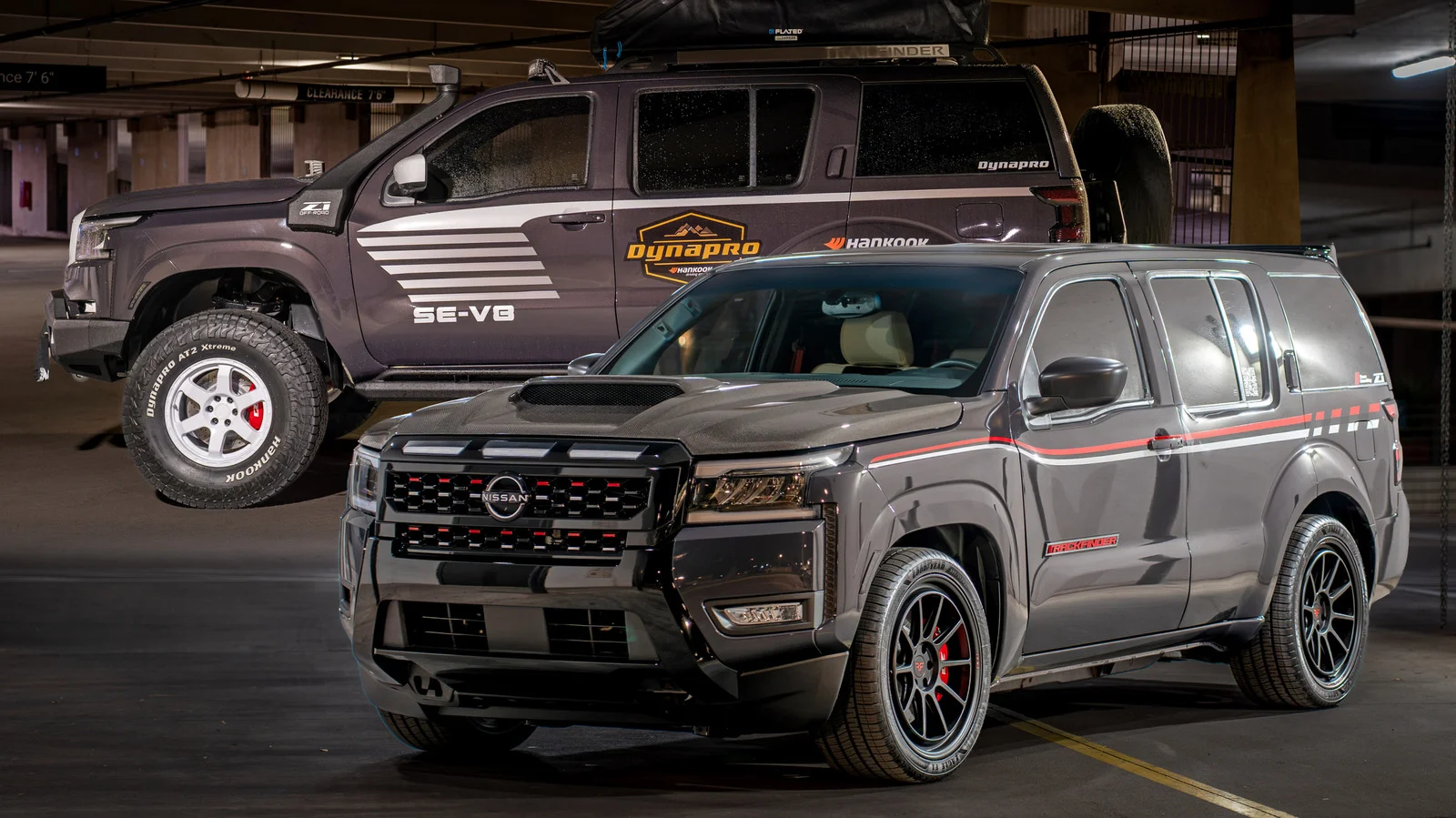
Nissan’s R51 Pathfinder gives builder Nicholas Scherr, known as Nismo Nick, a platform for two very different takes on the SUV: one set up for road performance, the other for rough terrain. The Trackfinder and Trailfinder are making their public debut at SEMA 2026 in Las Vegas, marking the Pathfinder’s 40th anniversary with a return to the model’s body-on-frame roots. Their shared starting point makes the contrast the story: both use the same generation and draw from the same parts bin, but they’re aimed at drivers who want very different things from an SUV.
Scherr chose the R51, the last Pathfinder generation built on a ladder frame, rather than the current unibody model. That choice matters to the builds’ identities. A ladder frame gives the Trailfinder a foundation suited to its lifted suspension and trail hardware, while the older truck-based platform also gives the Trackfinder a different character from a contemporary crossover-style SUV. The projects are personal interpretations, not evidence that Nissan is bringing back the Pathfinder’s former format.
Both builds borrow heavily from the D41 Nissan Frontier, including its grille, LED lighting, front fenders and doors, dashboard, center console and door panels. That parts sharing gives the two Pathfinders a common visual thread and updates the older cabin and exterior with newer Nissan truck design. Ruby Slate Pearl paint, first used on the 2021 Nissan Maxima 40th Anniversary, ties the builds together. It’s a deliberate bit of continuity across vehicles that otherwise head in opposite directions.
The pair follows Scherr’s V8-powered Xterra restomod, which appeared at SEMA the previous year. Here, the shared platform and parts give way to sharply different personalities. The distinction is unusually clear: one Pathfinder lowers its stance and adds a manual gearbox, while the other raises its body and equips it for off-road use.
Trackfinder pairs a supercharged V6 with a manual
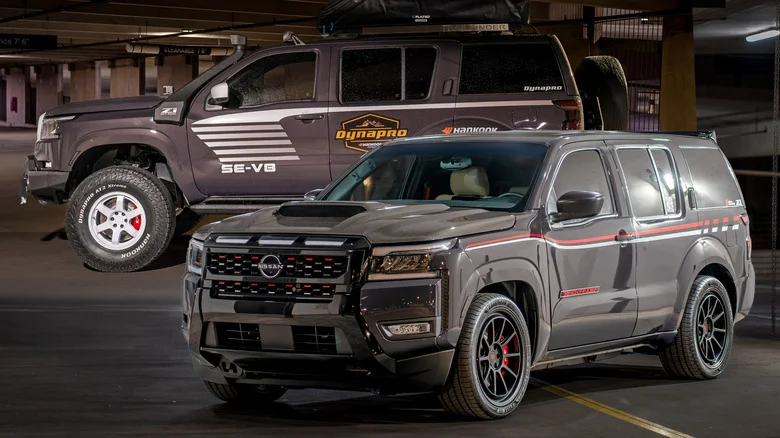
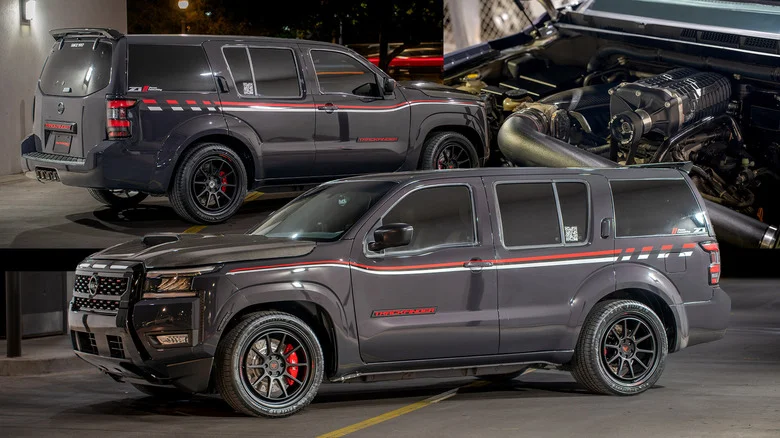
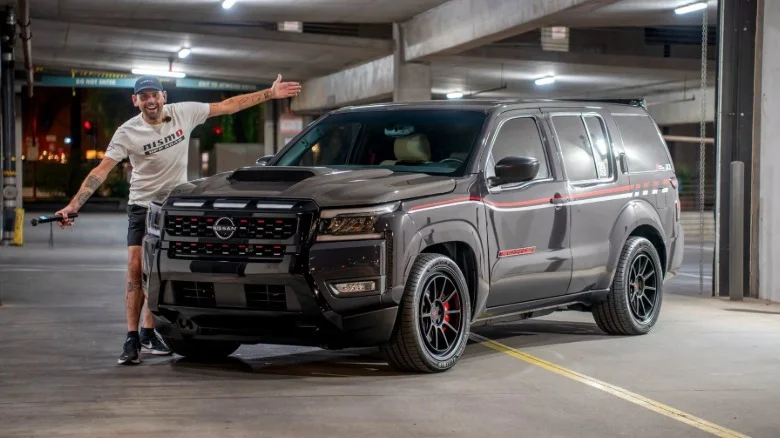
The Trackfinder takes a performance-oriented route, with a lowered stance and styling that nods to the GMC Typhoon. Black forged 20-inch wheels sit over cross-drilled and slotted brake discs with red calipers. Those details signal the build’s road focus, though they don’t tell us how it handles or stops in practice. The lowered posture also gives the older SUV a very different profile from the Trailfinder’s tall, tire-heavy look.
A Frontier-inspired front end gets glossy black trim and red details, while door logos, red-and-white side stripes, a Seibon carbon-fiber hood with a scoop, a rear spoiler and four tailpipes complete the exterior. There’s plenty to look at, but the mechanical choices carry more weight than the styling cues. This is more significant than it looks: pairing a supercharger with a manual gearbox changes the character of the R51, not just its appearance.
Its 4.0-liter V6 uses a Z1 Off-Road supercharger, custom carbon-fiber intake piping, a heat-shielded airbox and an UpRev tune. Output reaches 501 hp (374 kW / 508 PS), nearly twice the engine’s original figure. That’s a substantial claim for a project built around an older SUV, and it gives the Trackfinder a clear headline figure. The source doesn’t provide acceleration or handling results, so the output figure is the strongest measure of its performance ambitions.
Power runs through an Xterra six-speed manual gearbox, paired with a Centerforce clutch and flywheel. The gearbox is a choice that gives the driver a more direct role in managing the engine’s output. A manual swap can also make an unusual build feel more purposeful, even when the available details don’t establish how the finished package performs on a track. For enthusiasts who miss truck based SUVs with a hands-on driving character, that combination is likely the more intriguing part of the Trackfinder.
Trailfinder brings V8 power and off-road hardware
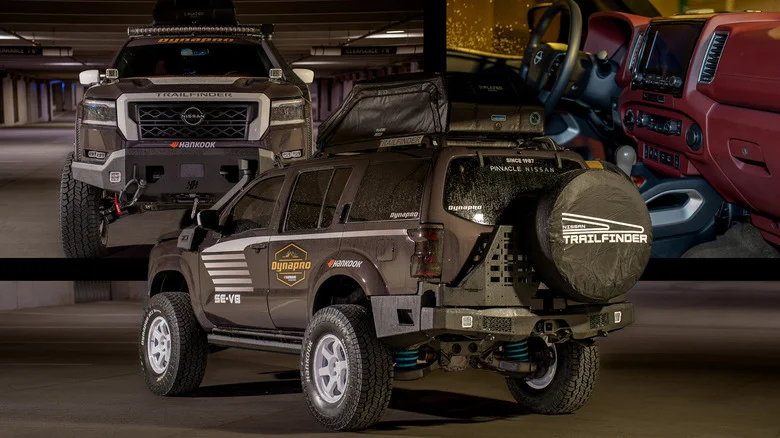
The Trailfinder leans into the body-on-frame formula with a lifted suspension and 35-inch Hankook Dynapro AT2 Xtreme tires on white alloy wheels. The tire size and added ride height establish its priorities quickly: clearance, traction and the ability to take on rougher ground. That doesn’t tell us how the vehicle behaves on a trail, but it shows that the build’s changes extend beyond decorative trim.
Hammerhead Armor steel bumpers and rock sliders add protection, while a front winch, recovery shackles and rear swing-out spare carrier prepare it for trail use. A roof rack carries a tent, and additional Rigid Industries LEDs add lighting. The collection is familiar from off-road builds because each piece serves a practical role, from carrying recovery gear to protecting bodywork. And this is the part most people overlook: accessories can suggest capability, but the source doesn’t describe testing or claim that the Trailfinder has been proven in difficult conditions.
A 5.6-liter V8 gets a Z1 Off-Road intake and snorkel. The suspension uses the X-Pro Titan Swap Package, with a Z1 Off-Road big brake kit. Together, those parts reshape the Pathfinder around power, clearance and control, although no output figure is given for the V8. The contrast with the Trackfinder is plain. One engine is supercharged and paired with a manual; the other is a larger V8 in a vehicle built around off-road equipment.
Inside, the Frontier-sourced dashboard wears red trim, matched to leather seats with tartan cloth inserts. Trailfinder branding appears on the grille surround, roof rack and spare tire cover. The cabin keeps the builds’ shared Nissan truck connection while adding a distinct finish for this version. A useful balance of shared parts and separate details.
What the two builds say about the Pathfinder
Pinnacle Nissan in Scottsdale, Arizona, supported both builds. Together, they show how far the R51 Pathfinder can be pushed in two directions: toward a manual, supercharged street machine or a V8-powered trail rig. The anniversary setting gives the projects a historical hook, but their appeal rests on the choices Scherr made with the old platform and the Frontier parts.
If you’re working in this space, the interesting lesson is how a single donor vehicle can support very different ideas when the builder is clear about the intended use. The Trailfinder makes the strongest case for the R51’s truck-based roots; the Trackfinder tests how far that same foundation can be redirected toward road performance. Neither build settles the question of whether the older format is better for every driver. That said, the pair makes the Pathfinder’s change in direction over time easy to see.
SEMA debuts put these builds in front of an audience that’s accustomed to heavily modified vehicles, so the specifications and visual contrasts have to carry the pitch. The Trailfinder has the more immediately legible mission, with tires, protection and recovery equipment all pointing toward rough terrain. The Trackfinder’s manual conversion is the more surprising choice. Two distinct answers to the same question: what can an R51 become?
 Nick Scherr

Discussion
Sign in to join the discussion.