Castagna Milano’s unbuilt Giulia Quadrifoglio concept trades four doors for a carbon-fiber body, two seats and a folding soft top.
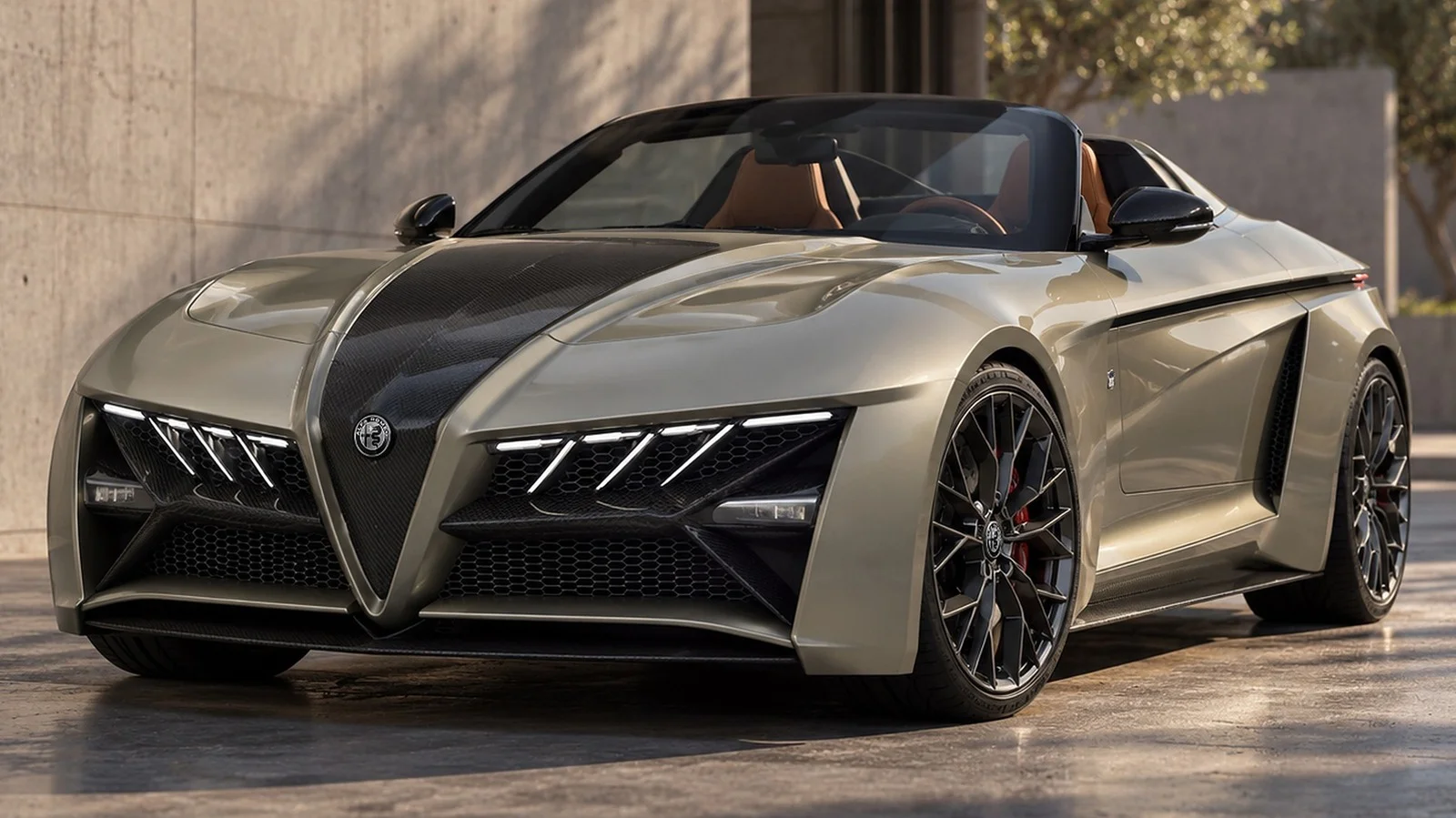
Castagna Milano’s Giulia Quadrifoglio proposal makes a strong case for giving Alfa Romeo’s high-performance sedan a two-door, open-top counterpart. The coachbuilder has sketched a two-seat sports car based on the Quadrifoglio, but the project remains theoretical: it depends on finding an owner willing to provide a Giulia for the conversion. That distinction matters. A rendering can communicate proportion and intent, while a working car has to answer questions about structure, packaging and the compromises that come with changing a sedan into a convertible.
The idea draws on Castagna Milano’s long history. Founded in 1849 to build carriages for wealthy clients, the company closed in 1954 and returned in the early 2000s. Since then, it’s produced bespoke versions of Fiats, Peugeots and other cars, work that puts this proposal in a familiar tradition of tailoring an existing vehicle rather than developing a new one from scratch. The Giulia concept taps into the same appetite for low-volume, individually tailored design, but its scale of change appears more ambitious than a cosmetic redesign.
That ambition is also the proposal’s central appeal. The Quadrifoglio already supplies the identity and mechanical starting point; Castagna’s task would be to make the finished car feel like a coherent two-seat sports car in its own right. For now, the renderings show what that might look like, not what the conversion can deliver on the road.
A different layout and a lighter body
Castagna’s changes would reach well beyond removing the rear doors. It proposes moving the seats, steering wheel and dashboard 330 mm toward the rear axle, creating room for a longer hood and changing the relationship between the cabin and the car’s front end. That shift would give the car a more pronounced sports-car profile, with the occupants seated farther back than in the standard sedan.
The change would affect more than appearance. Moving major cabin components alters how the car is packaged, and Castagna says the revised position would shift weight distribution. The proposal doesn’t give a new distribution figure, so the handling effect can’t be assessed from the available details. Still, it’s a meaningful design decision: the project isn’t simply shortening the cabin by deleting rear doors; it’s reorganizing the front half of the car around a different seating position.
The concept’s nose combines an Alfa Romeo triangular grille with dark air intakes and a chin spoiler. Its claw-shaped daytime running lights recall recent Peugeot designs, an identifiable visual reference that also reflects Castagna’s history of working with different manufacturers’ cars. The design has to balance those cues with the Giulia’s existing identity. Get that balance wrong, and the result could look like a collection of parts; get it right, and the conversion could read as a distinct Alfa Romeo-derived model.
Carbon fiber would be used for all the new body panels, while the two-door layout could bring the car’s weight down to 1,420 kg. That figure is a projection tied to a concept, not a confirmed weight for a completed vehicle. Carbon fiber can help limit the mass added by new panels, but a body conversion involves more than the material choice. The final structure, reinforcements and equipment would all affect the finished car’s weight.
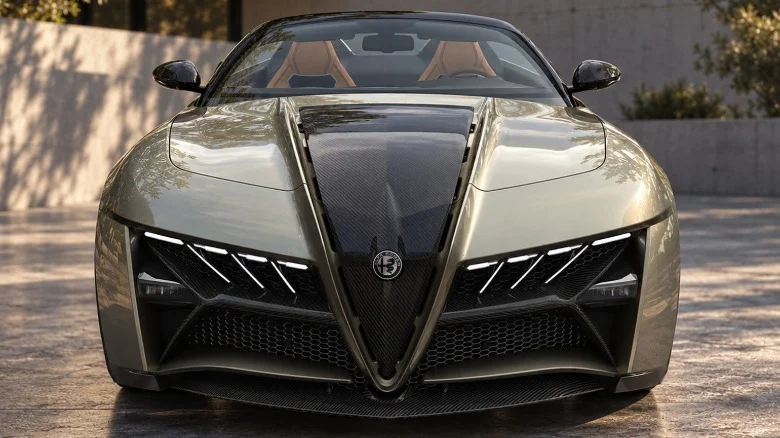 Castagna Milano
Open-air Quadrifoglio, with engineering questions
Renderings show reshaped front and rear quarter panels, distinctive doors and bespoke wheels. At the back, thin LED lights sit above stacked exhaust outlets and a carbon-fiber diffuser. The defining change is a folding soft top, turning the Giulia-based coupe into a convertible. Taken together, those details suggest a car designed as a complete visual package, though the images can’t show how the roof and body would work under real driving loads.
Castagna hasn’t explained how it would preserve body rigidity without a fixed roof. That’s a major engineering question for any conversion of this kind. The roof contributes to a car’s structure, and removing it can make the body more prone to flex; reinforcing the chassis would likely be necessary to control that movement. Such reinforcement can bring extra weight and affect packaging, so it could complicate the concept’s aim of producing a lighter car.
Here’s the thing: the proposed 1,420 kg figure only tells part of the story. A lower mass would be attractive in a high-performance car, but the build would still need to reconcile that target with the structural demands of an open-top body. The drawings don’t establish whether Castagna has solved that problem, and the company hasn’t presented a completed car to demonstrate how the design behaves. A compelling silhouette is a start. It isn’t proof of a finished engineering package.
The engine gives the concept a clear foundation
The standard Giulia Quadrifoglio’s twin-turbo 2.9-liter V6 gives the proposal a compelling mechanical foundation. It also powers the Stelvio Quadrifoglio and is known for its distinctive sound. Keeping that engine would preserve a direct link to the car Castagna is adapting, while the new body and seating layout would give the familiar hardware a different setting.
That combination is central to the concept’s appeal. An established performance engine gives the project a recognizable character from the outset, but the conversion would still need to make the rest of the car match its promise. Changes to the body, cabin and weight distribution can alter how a vehicle feels, and the available renderings don’t reveal the finished car’s performance or driving behavior. If you’re working in this space, that’s the distinction to keep in view: the proposal has a credible starting point, but its most consequential choices remain untested.
What a completed build would have to prove
Castagna’s concept speaks to a particular kind of buyer: someone who wants the performance identity of a Giulia Quadrifoglio in a rarer, more personal shape. This is more significant than it looks, because a successful coachbuilt conversion has to satisfy two audiences at once. It must honor the donor car’s character while making the alterations feel purposeful enough to justify the transformation.
(And this is the part most people overlook.) The project depends on an owner supplying a Giulia, so the next step isn’t simply refining the renderings; it’s finding a basis for a real build. That would bring the design’s unanswered questions into focus, from the roof structure to the final weight. The concept remains a set of renderings for now. A striking outline, and a long list of work still ahead.
Discussion
Sign in to join the discussion.