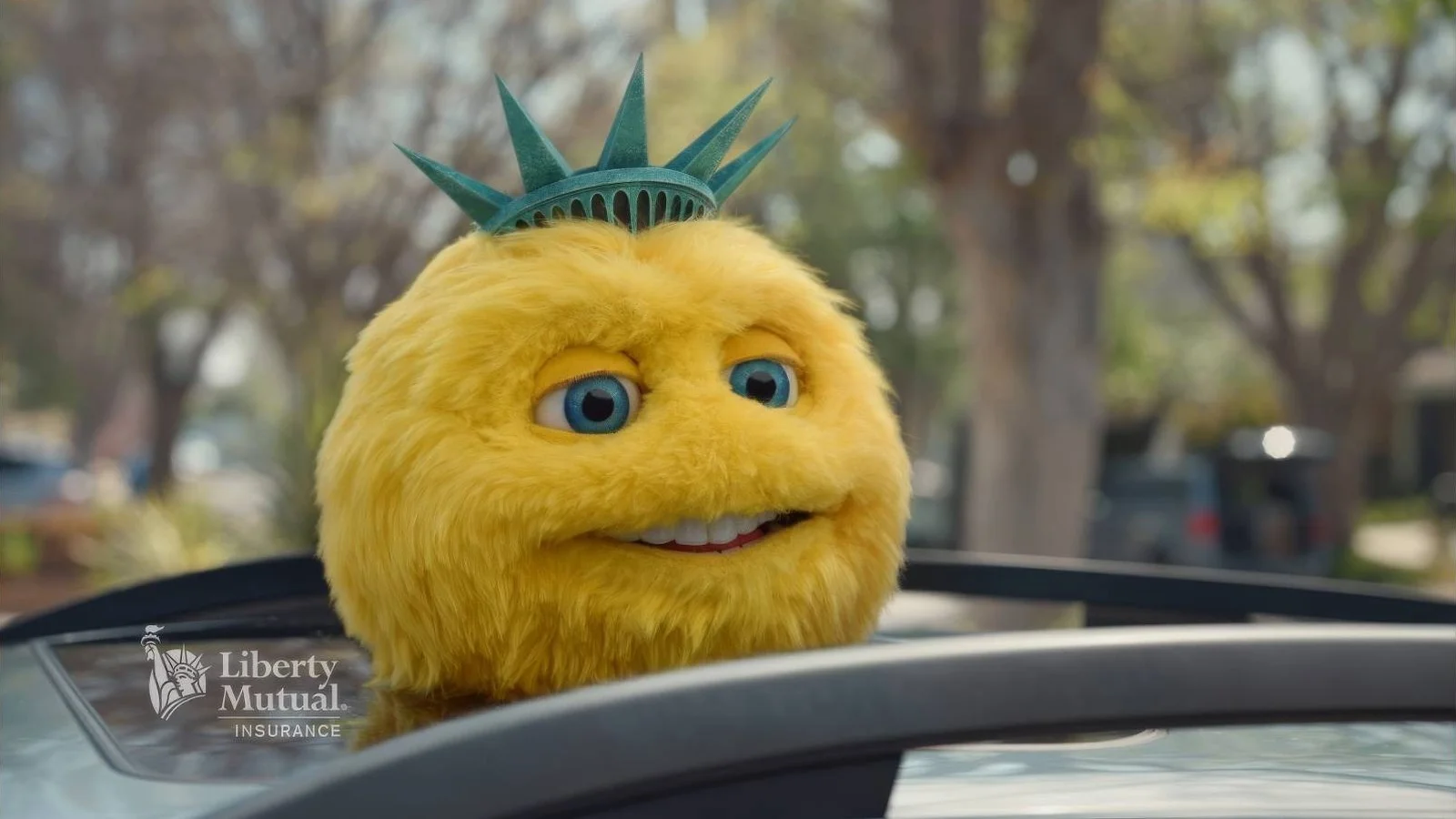
Liberty Biberty’s unsettling look has sparked protests and online backlash. The character came from Jim Henson’s Creature Shop, though its Muppet status is debatable.
A mascot becomes the story
Liberty Biberty has become an unusually effective attention magnet for Liberty Mutual. The yellow character in the insurer’s latest ad has drawn online ridicule and even a protest outside the company’s Boston headquarters, turning a commercial mascot into a small public spectacle. That shift matters: the campaign is now being discussed not only as advertising, but as a question of taste, authorship, and what audiences expect from a familiar kind of character.
Advertising mascots are designed to make a company recognizable and give a campaign a personality that can outlast any one commercial. But recognition doesn’t guarantee affection. A character can stick in people’s minds because it’s charming, irritating, strange, or some mix of all three. Biberty’s reception suggests that Liberty Mutual has achieved the first part of that equation: people know the character well enough to have strong opinions about it.
That attention has come with a cost in control. Once viewers begin sharing jokes and organizing around a character, a company can’t dictate what the character means to them. Liberty Biberty is still part of an ad campaign, but the online reaction has given it another life as a subject for public commentary. A small spectacle, perhaps, but a spectacle all the same.
From online ridicule to a Boston protest
Connor Harvey, a 19-year-old YouTuber, urged people to join the protest in a video called “Death of Mascots.” He framed the effort as “the next Boston Tea Party” and said it was meant “to take down Liberty Biberty here on Liberty Mutual's Headquarters.” Harvey said the demonstrations would remain peaceful and that he’d leave if the company asked.
The language gives a protest over an advertising character a deliberately grand frame. That gap between the theatrical pitch and the modest object of the protest is part of the story: the mascot is being treated as a public irritant, while the protest itself becomes another piece of content for people to watch, share, or mock. The character has moved beyond the commercial without leaving the commercial behind.
There’s no need to assume that everyone involved sees the protest in the same way. Harvey’s video states his framing and his intention to keep the event peaceful; it doesn’t establish what every attendee thought or how many people would take part. The distinction matters when an online call becomes a real-world gathering. A vivid phrase can spread faster than the details around it.
The joke has a sharper edge
The reaction has ranged from jokes to genuine distaste. The Boston Globe quoted one young protester comparing Biberty unfavorably with AI: “I am against AI, but this is much worse; this is the worst thing a human can create.” The irony is that Biberty isn’t AI-generated. Jim Henson’s Creature Shop made the character, and the team shared a behind-the-scenes post documenting its creation.
The protester’s comparison works as an insult, not as a claim about how the character was made. That distinction is easy to lose once a joke gets repeated online. In this case, the production history gives the criticism an extra twist: the character’s visibly crafted origins are part of the response, yet they haven’t protected it from being judged as an aesthetic failure.
That’s a familiar problem for character design. A production team can bring considerable skill to a puppet or costume, but workmanship and audience appeal are separate questions. The behind-the-scenes post can show how the character came together; it can’t settle whether viewers like what they see. And this is the part most people overlook: evidence of effort often changes the conversation, but it doesn’t automatically change the verdict.
Creature Shop credentials don’t settle the Muppet question
Here’s the distinction: a creature built by Jim Henson’s Creature Shop doesn’t automatically become a Muppet. Disney acquired the Muppets in 2004, and Biberty appears on the Muppet Wiki’s Liberty Mutual page. But the character isn’t included in Wikipedia’s list of Muppets, leaving its official status open to interpretation.
Those references don’t carry the same weight. One is a fan-maintained wiki that includes Biberty on a page about Liberty Mutual; the other is an encyclopedia list that doesn’t include the character. Neither detail, by itself, resolves the question. The available facts support a narrower conclusion: the Creature Shop made Biberty, and people disagree—or may simply use different standards—about whether that makes the character a Muppet.
The same line came up in “Star Trek: Strange New Worlds.” Its episode “Level 5 Transporter Incident” featured characters made by the Henson Creature Shop, but they weren’t Muppets either. The craftsmanship connects the projects; the label doesn’t necessarily follow.
That example helps separate a workshop’s identity from the identity of the characters it creates. A production company can make creatures for different projects without giving every one of them the same name or cultural status. The distinction may sound technical, but it explains why “made by the Creature Shop” doesn’t end the discussion. Craft is a fact about production; “Muppet” is also a category audiences interpret.
Attention isn’t the same as approval
That distinction may matter less to Liberty Mutual than the attention Biberty is getting. The character has people talking, even if plenty of them would prefer not to look at it. For now, Biberty’s clearest claim to cultural relevance is that a campaign mascot has managed to provoke a debate about what counts as a Muppet.
This is more significant than it looks, though not necessarily in the way an advertiser would hope. A mascot that prompts discussion can earn recognition, but the discussion may center on the character’s oddness rather than the company or message behind it. Publicity and approval aren’t interchangeable. If you’re working in this space, Biberty is a reminder that attention can be measured in conversation while sentiment remains plainly divided.
There’s a limit to what can be inferred from the reaction described here. A protest, a sharp quote, and online ridicule show that the character has provoked some people; they don’t establish how a wider audience feels or whether the campaign has succeeded by any business measure. Still, the episode illustrates a useful tension for brands: a mascot must be distinctive enough to be remembered, but the same qualities that make it distinctive can make it a target.
For now, the argument is less about whether Biberty is technically a Muppet than about who gets to define the category, and whether the label changes anything for viewers. The character’s production history is clear. Its cultural standing is messier. That’s a strange return for an advertising campaign, and a more durable topic than the usual question of whether a commercial was funny.


Discussion
Sign in to join the discussion.