A restored 2002 Lada Niva Marsh is listed in Germany for €19,999, pairing huge low-pressure tires with a modest 79 hp engine.

The Lada Niva Marsh was built for terrain that can swallow ordinary off-roaders, with a design centered on keeping the vehicle moving over soft ground. A restored 2002 example is now listed in Germany for €19,999 ($22,400), giving buyers a rare opportunity to consider one of fewer than 1,000 Marsh conversions believed to exist. That scarcity may draw attention, but the vehicle’s appeal depends just as much on whether its specialized hardware suits the work its next owner has in mind.
The listing on Mobile.de describes the Niva as professionally restored. That wording gives a potential buyer a useful starting point, though the listing details remain the source for what’s being offered; restoration claims are most meaningful when backed by clear records and a close inspection. The Marsh’s core appeal is easier to define: enormous low-pressure tires, custom axles and suspension, and low-range gearing are intended to help this compact Soviet-era 4x4 handle snow, mud and waterlogged ground.
Built around flotation
The Marsh’s balloon-like tires are central to its purpose. Their broad contact patches help distribute the vehicle’s weight over soft surfaces, while their size also provides clearance. That combination can help reduce the risk of sinking where narrower tires would struggle, although the results still depend on the ground and how the vehicle is driven. This is specialized equipment for a narrow kind of problem, not a general guarantee of passage.
The body has been altered to make room for the tires, with wide tractor-style fender extensions and integrated mud flaps. Those additions give the Niva a markedly different profile from the standard vehicle and serve a practical role by covering the tires’ wider footprint. This example wears purple paint, a conspicuous choice that could make it easier to spot against snow. It’s an unusual detail on a machine whose working parts already make it hard to mistake for an ordinary 4x4.
Bull bars at both ends add protection against light impacts with rocks or trees, while the conversion replaces the Niva’s familiar round headlights with rectangular units and uses aftermarket taillights. Together, those changes make the Marsh look closer to a small expedition machine than a standard road-going Niva. The styling signals the conversion’s purpose, but the more consequential question is how the altered axles, suspension and tires work together in the conditions the owner expects to encounter.
Modest power, specialized hardware
There’s no high-output engine to match the Marsh’s imposing stance. It uses a naturally aspirated 1.7-liter four-cylinder producing 79 hp (59 kW / 80 PS), paired with low-range gearing. That figure puts the emphasis on traction and controlled progress rather than rapid acceleration, and the low gearing is suited to keeping the wheels turning at slow speeds. Straight-line speed isn’t the point.
In this category of vehicle, power alone says little about how well a machine will cross soft ground. Tire contact, gearing and the driver’s ability to maintain momentum all shape the result, while the Marsh’s size and weight also matter. The conversion’s hardware is meant to address a specific challenge: reaching places where ordinary off-road vehicles may bog down. It can’t make every surface passable, and it isn’t a substitute for judging conditions carefully.
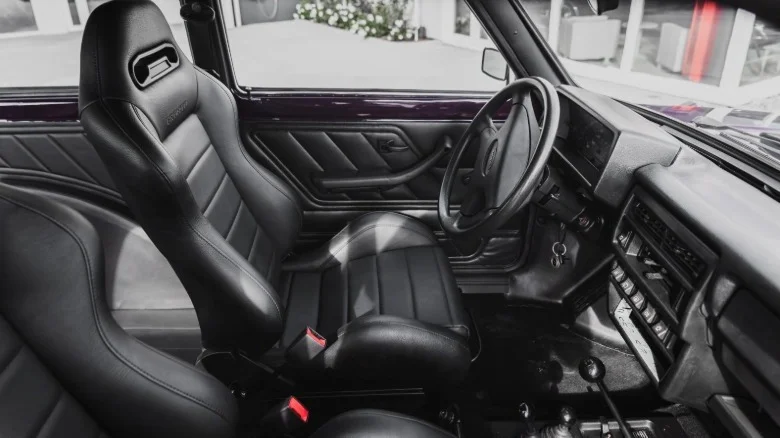
The cabin retains the utilitarian layout of an early-2000s Niva, with Bronto lettering on the steering wheel and bucket seats. That interior is a reminder that the Marsh’s transformation centers on its running gear and bodywork, rather than a wholesale move toward modern comfort. For someone buying it to use in difficult terrain, that may be an acceptable trade. For a driver expecting a contemporary daily vehicle, the age and basic cabin will be harder to overlook.
Bronto, a specialized AvtoVAZ subsidiary, built the Marsh and the rugged Niva Bronto. The shared name points to the conversion’s maker, but the Marsh’s defining feature is its flotation-focused setup. Buyers seeking a newer take can also consider Lada’s recently unveiled Niva Legend update, which adds galvanized body panels, a driver airbag, improved insulation and air conditioning, plus a more powerful engine. Those additions address everyday comfort and equipment; they don’t make the Legend the same kind of specialized machine.
What the Marsh is built to do
This is more significant than it looks: the Marsh represents a design choice that many off-road vehicles don’t make. Instead of prioritizing speed, comfort or broad road use, it concentrates on floating over soft, difficult ground. That focus explains both its distinctive appearance and its compromises. The enormous tires are the point, but they also make the vehicle a more specialized proposition than its Niva roots might suggest.
If you're working in this space, the practical question is whether you need that particular ability often enough to justify owning a conversion built around it. A low-range gearbox and broad tires can be useful in the right conditions, but capability on one kind of terrain doesn’t automatically translate to convenience elsewhere. (And this is the part most people overlook.) A rare vehicle can be interesting to own and still demand careful thought about where, how and how often it’ll be used.
The asking price places this restored example in the hands of buyers prepared to weigh rarity against specialization. The listing establishes the price and describes the vehicle as professionally restored, while the claim that fewer than 1,000 Marsh conversions are believed to exist gives its scarcity context. Neither point answers the practical questions about a particular vehicle’s condition or suitability for a buyer’s needs. Those details matter. The Marsh’s proposition remains clear: it trades speed and modern cabin features for flotation and access to soft, difficult ground.


Discussion
Sign in to join the discussion.