Gunther Werks will build five Brundle Edition Turbos, pairing an 860-hp air-cooled flat-six with a carbon-fiber body and Martin Brundle-inspired details.
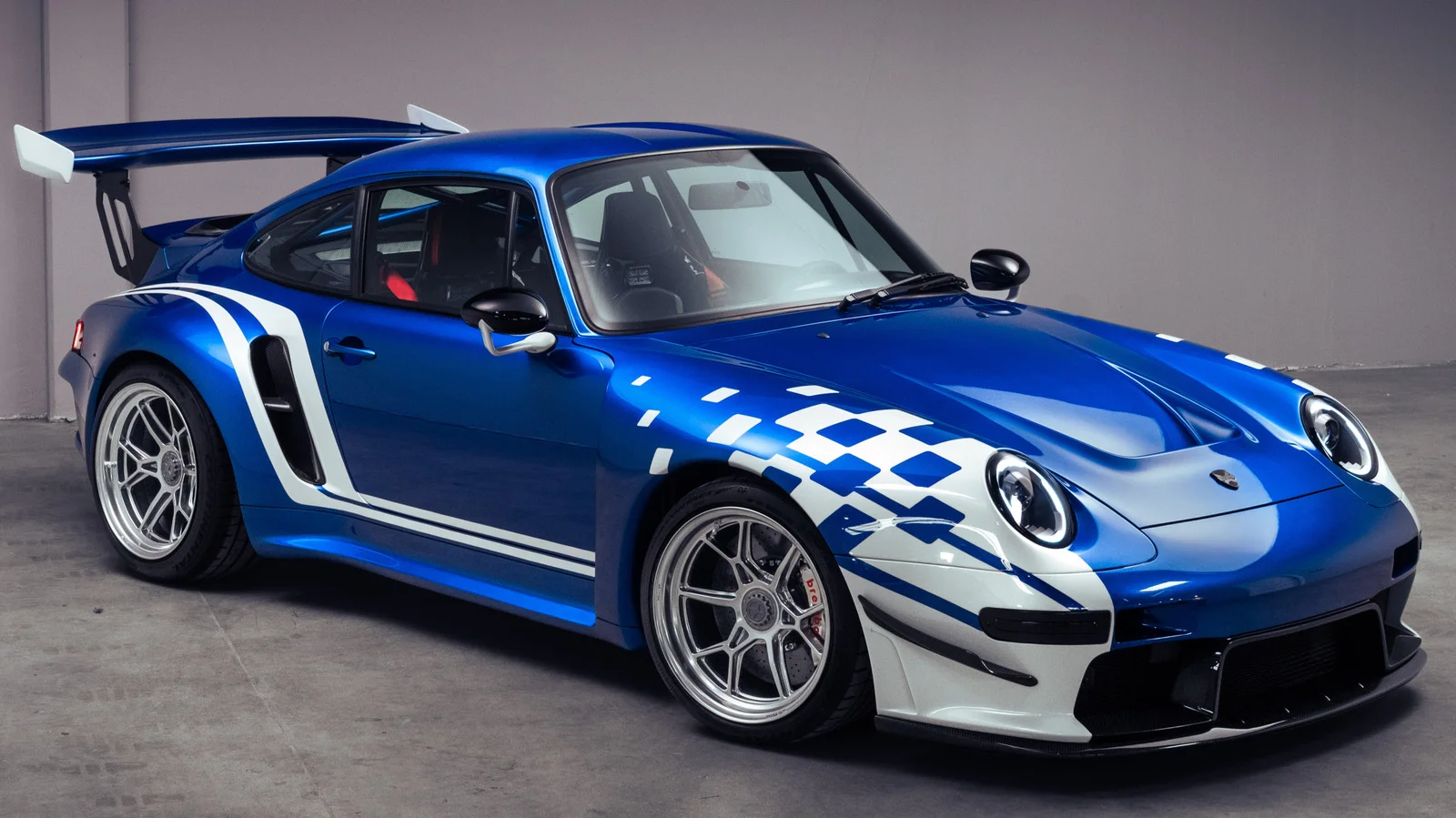
Gunther Werks’ Brundle Edition Turbo makes its case through a rare combination: 860 horsepower, a six-speed manual and a claimed 2,700-pound curb weight. Just five examples are planned, and the company hasn’t announced pricing. Those figures set expectations before a buyer even considers the paint or interior: this is a highly exclusive, heavily modified 993-based 911 aimed at drivers who want a direct connection to the car as well as considerable power.
The headline numbers also leave practical questions unanswered. Gunther Werks hasn’t supplied acceleration or top-speed figures, so the Brundle Edition’s performance can’t be judged from output and weight alone. Power delivery, gearing, tires and chassis setup all shape how a car behaves, especially when a manual gearbox puts more of the driving work in the owner’s hands.
Turbo power, delivered through a manual
The limited-run model draws on Gunther Werks’ existing Turbo platform. Its air-cooled, twin-turbo 4.0-liter flat-six produces 610 lb-ft of torque, while Mahle pistons, forged connecting rods, individual throttle bodies, a billet crankshaft and stainless-steel headers support the output. A Motec ECU manages the engine, which sends power to the rear wheels through a Getrag six-speed manual gearbox.
That specification combines modern engine management and extensive internal upgrades with a transmission that asks the driver to work through each gear. The contrast is part of the car’s appeal: electronics oversee the engine, but the manual gearbox keeps acceleration tied to timing and driver input. With 610 lb-ft available, the setup also suggests that smooth control will matter as much as the ability to reach for the next gear.
This is more significant than it looks. A manual transmission can give a high-powered car a more involving character, but it also makes the quality of the gearing and chassis calibration central to the experience. The figures establish the Brundle Edition’s intent; they can’t tell you how forgiving it’ll be when the road gets uneven or the driver pushes harder.
Chassis hardware for road and track
The suspension combines bespoke coilovers, custom anti-roll bars, double wishbones and a front strut brace. A hydraulic nose lift helps with steep entrances, a practical concession for a low car whose owners may still need to get through ordinary driveways and ramps. The arrangement points toward track use while acknowledging that the car won’t live exclusively on a smooth circuit.
Brembo brakes use six-piston front calipers and 14-inch discs, with four-piston rear calipers and 13.6-inch discs. Buyers seeking lower unsprung weight can specify carbon-ceramic rotors. That option addresses a familiar tradeoff in performance-car design: reducing weight at the wheels can benefit how the suspension responds, while the standard steel setup keeps the car’s baseline specification simpler.
The claimed 2,700-pound curb weight supports the performance pitch, especially alongside the engine output. But the absence of acceleration and top-speed figures makes it difficult to compare the car’s speed with its ambitions. The available details describe serious hardware; they don’t yet show how the complete package performs.
A personal design, built around Brundle’s racing history
Charlie Brundle, Martin Brundle’s daughter and an automotive designer, led the styling. The blue paint takes its cue from her father’s racing helmet, while white accents trace the fenders, doors and rear-wing endplates. The wing’s adjustable angle gives owners a way to tune it for track use, linking a visual feature to a functional choice.
Most exterior panels are carbon fiber. Standard equipment includes 18-inch, three-piece forged aluminum wheels, while optional two-piece forged magnesium and carbon-fiber wheels take inspiration from Brundle’s former Brabham Formula One car. The options extend the racing references while also affecting the car’s weight, though the source doesn’t specify how much weight either wheel choice saves.
The cabin carries the same personal touches. Carbon-fiber bucket seats wear black and red trim, with an MB logo on the headrests and red door accents. A line attributed to Brundle appears on the dashboard: “The most important bit of the car is the nut holding the steering wheel.” Each car also comes with a Bell HP77 helmet finished to match the blue, white, red and carbon-fiber theme.
The helmet and personalized cabin make the ownership experience part of the design brief (and this is the part most people overlook). They turn the car into a curated object as well as a collection of performance components, with a specific family story behind its colors and details. That story won’t replace the need for convincing driving dynamics, but it gives the five examples an identity beyond their engine output.
What the five-car run signals
At the unveiling, Brundle described the appeal as a blend of extreme performance and everyday usability. “To collaborate with Gunther Werks and to have my daughter lead the design means this project is deeply personal,” he said. The combination of family authorship, racing references and serious mechanical upgrades gives the limited run a clearer identity than horsepower alone can provide.
Scarcity, however, tells only part of the story. Just five examples are planned, but pricing remains unannounced, and the available information doesn’t establish how the car balances track focus with daily use. If you're working in this space, the useful question is whether the bespoke suspension, hydraulic nose lift and manual drivetrain make the car rewarding across both settings. The answer will depend on the finished car’s behavior, not its specification sheet.
For now, the Brundle Edition reads as a deliberately focused reinterpretation of the 993: air-cooled character, turbocharged power, a manual gearbox and design details tied to a particular racing family. A compelling brief.
Discussion
Sign in to join the discussion.