BYD's ETT 44 electric truck showcases superior specs and charging capabilities compared to the Tesla Semi, setting a new standard for heavy-duty electrification.
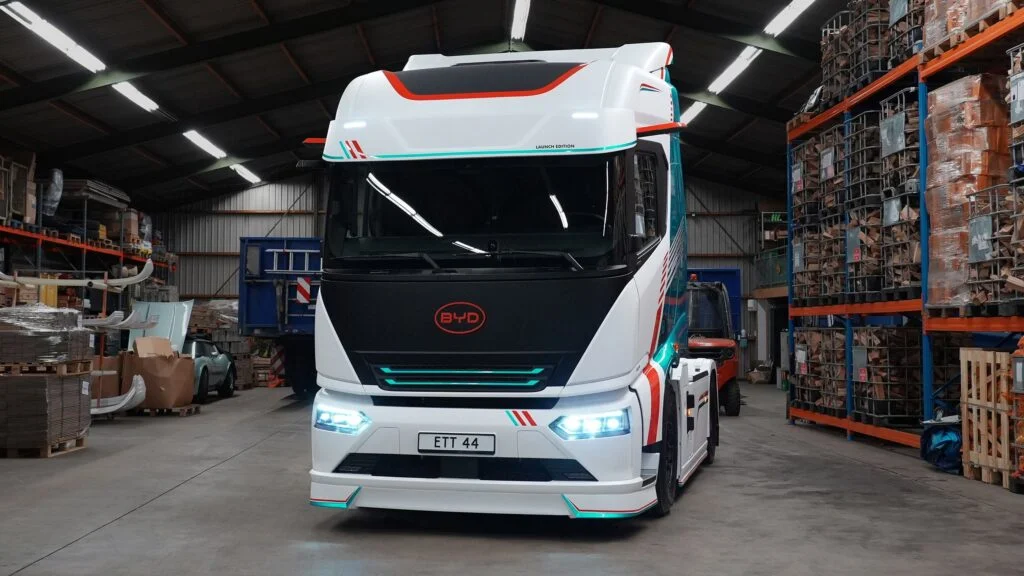
At the IAA Transportation 2026 in Hannover, BYD has unveiled its newest electric flagship for Europe, the ETT 44, which is poised to disrupt the long-haul transport industry with impressive power and advanced features. This launch comes at a critical time for electric vehicle manufacturers as the push for sustainable transport continues to intensify globally.
Key Specifications
The ETT 44 is engineered with up to 1,006 hp and incorporates a large 651 kWh Blade battery that supports an impressive 1.5 Megawatt charging, allowing drivers to gain 248 miles of range in just 20 minutes. This level of performance is indicative of a broader industry trend towards higher-efficiency electric powertrains. Many analysts suggest that rapid charging capabilities will be essential for long-haul electric trucks if they are to gain traction among fleet operators who depend on maximized uptime.
Design and Interior Features
Maintaining a familiar look, the ETT 44 features an upright cab-over design that aligns with BYD's existing heavy-duty models like the ETH 20 and ETH 28. The launch edition stands out with aerodynamic enhancements, a unique grille, and a high-roof sleeper cab layout — fundamentally aimed at driver comfort, reflecting a shift in how design is driven by user experience in commercial transport. This design could effectively reduce air resistance, leading to improved energy efficiency.
Inside, the truck excels with a digital instrument cluster and an easy-to-navigate centralized 12.8-inch infotainment display. You'll find that advanced safety features are backed by physical controls, a user-friendly car-like gear knob, and ample storage options, ensuring that drivers have a practical experience. The driver bed, which is conveniently situated behind the seats, optimizes space. Air suspension contributes to a smoother ride, while a comprehensive suite of advanced driver-assistance systems (ADAS) plays a crucial role in enhancing safety and ease of operation. If you're working in this space, you know how even small innovations can have large impacts on driver fatigue and safety statistics.
Powertrain and Performance
Under the hood, the ETT 44 competes fiercely against rivals like the Tesla Semi, boasting a powerful single motor that produces up to 1,006 hp (or 750 kW). It comes with two battery options: a 434 kWh variant providing a range of about 400 km (249 miles) and a larger 651 kWh option offering up to 600 km (373 miles). That’s a substantial amount of range for electric trucks, whose viability is often questioned due to charging infrastructure limitations.
Charging rates are noteworthy; the base model supports a maximum of 950 kW, while the long-range variant escalates to 1,500 kW, enabling a 20-80% charge in only 20 minutes with a compatible MCS charger. For context, Tesla's Semi offers a lesser range of 550 km (342 miles) and maxes out at 800 kW charging speeds. What this means for buyers is that BYD is clearly focusing on minimizing downtime—a significant concern for operators in the fast-paced shipping and logistics industry.
Dimensions and Weight Capacity
With dimensions of 6,400 mm (252 inches) in length, 2,530 mm (99.6 inches) in width, and 3,820 mm (150.4 inches) in height, the ETT 44's footprint aligns with competitors like the Mercedes-Benz eActros 600 and Scania 45 R Electric. This standardization in size helps simplify operations and logistics, allowing fleet managers to interchange vehicles where necessary.
The curb weight of the ETT 44 ranges from 10,950 kg to 11,140 kg (24,141 lbs to 24,560 lbs), with a gross weight rating of 20 tons (44,092 lbs) and a gross combination weight of 44 tons (97,003 lbs), closely following European regulations. BYD asserts that the truck is capable of handling gross combination weights up to 65 tons (143,300 lbs). This capacity notably surpasses the Tesla Semi's maximum of 40 tons (80,000 lbs), although Tesla's model remains lighter at 9,100 kg (20,062 lbs). This difference points to the trade-offs between weight and performance, a consideration that fleet operators must evaluate carefully.
Market Expectations
While pricing for the ETT 44 has not been disclosed, it’s set to launch on European roads soon. A standard 10-year or 1.2 million km (750,000-mile) warranty on the battery offers significant reassurance for prospective buyers, reflecting BYD's confidence in their electric technology. It indicates an understanding of the longer-term nature of fleet operations where maintenance and repair costs are critically calculated. As electric vehicles begin taking larger shares of the market, warranties like this might become a focal point for decision-making among fleet operators.
Implications for the Industry
The emergence of the ETT 44 isn’t just about performance specs; it's about shifting paradigms in the heavy-duty trucking sector. If BYD can successfully penetrate the European market with this model, it might compel established manufacturers to accelerate their own electric offerings. The competition in this space is fierce, and while many traditional manufacturers are transitioning towards electric, BYD’s early lead could establish it as a front-runner in the long-haul sector.
And this is the part most people overlook: the sustainability narrative surrounding transportation is gaining traction, with businesses under increasing pressure to lower carbon footprints. If fleets transition to electric options that promise lower lifetime costs and emissions, we could see a tipping point in how logistics and transportation services are structured.
In a nutshell, while the BYD ETT 44 holds impressive specifications, its true success will hinge on infrastructure development, market conditions, and acceptance among fleet operators. Time will tell if it paves the way for a new era in sustainable transport.

Discussion
Sign in to join the discussion.