Hyundai and Kia draw on shared engine families and EV hardware, helping cut costs while spreading some reliability issues across both lineups.
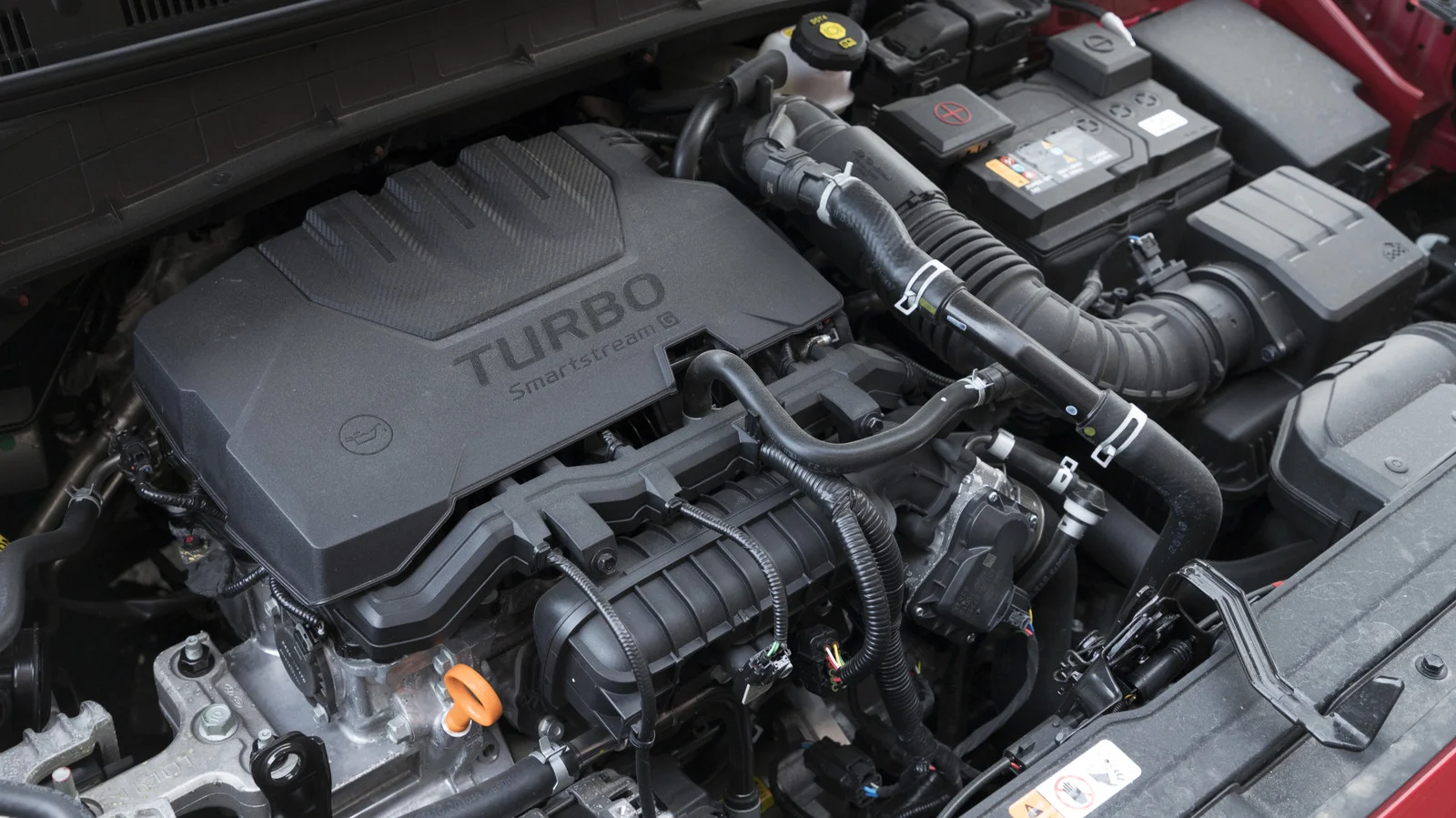
Hyundai and Kia share more than a corporate history: many models use the same engines and electric vehicle hardware. That common engineering can lower development and manufacturing costs, but it also means a problem in one powertrain family may affect cars carrying either badge.
The relationship took shape after Kia declared bankruptcy in 1997 and Hyundai bought a 51% stake. Today, the brands share vehicle architectures and powertrains, while keeping distinct model lineups and styling.
Shared engines span several model lines
The 2.2-liter CRDi turbodiesel is one of the clearest examples. Hyundai and Kia have used the inline-four in the Santa Fe and Sorento since 2009. It’s also appeared in the Hyundai Palisade and Sonata, and the Kia Carnival. Built in South Korea, the engine is generally regarded as reliable, though piezo-electronic injector faults can cause poor running and costly repairs. Some owners have also reported oil consumption as high as 0.5 liters per 600 miles.
Petrol engines cross the lineup, too. The Smartstream turbocharged 2.0-liter inline-four is available in models such as the Hyundai Santa Fe and Sonata and the Kia K5, mainly in Asian markets. A related 2.5-liter turbo four powers the Hyundai Sonata N Line and Kia Sorento, along with several Genesis models. Reports have also linked it to the next generation of Hyundai N cars.
Both brands also use the Smartstream G3.5, a 3.5-liter V6. Hyundai builds a twin-turbo version for Genesis. Sharing these engines lets the companies spread engineering and production costs across more vehicles, without building separate supply chains for each brand.
US production and warranty coverage
Some Hyundai engines are manufactured in the United States, including the Smartstream G2.5 GDi and T-GDi, G1.6 T-GDi, and G2.0 Atkinson. That means US-built versions of vehicles such as the Kia Telluride and Sportage, and the Hyundai Tucson, Santa Cruz, and Santa Fe, may use engines assembled domestically. Hyundai has also been expanding North American production.
Most current engines are considered solid, and US buyers receive a standard 10-year or 100,000-mile warranty. But the shared parts strategy has a tradeoff: when an engine family develops a widespread fault, vehicles from both brands can be affected.
Past engine problems crossed brand lines
The Nu 1.8-liter and 2.0-liter inline-fours, along with the Theta II 1.8-liter, 2.0-liter, and 2.4-liter engines, faced recalls and reports of stalling, seizure, and fires. In 2024, Hyundai and Kia agreed to settle a US class-action lawsuit, offering cash rebates to affected owners and extending engine warranties to 15 years or 150,000 miles.
Among the affected vehicles were the 2011–2015 Hyundai Sonata Hybrid, 2014–2021 Hyundai Tucson, 2011–2016 Kia Optima Hybrid, and 2011–2013 Kia Sportage, as well as other models. The episode shows how a shared engine can carry the same reliability concern across multiple nameplates.
EVs share hardware, too
The overlap extends to electric vehicles. The Kia EV6, Hyundai Ioniq 5 and Ioniq 9, and Genesis GV60 use the 800-volt E-GMP platform, with shared battery packs and electric motors. The Hyundai Ioniq 3 and Kia EV4 use a 400-volt version of the architecture.
Some EVs with common components have experienced failures in the Integrated Charging Control Unit, which can leave a vehicle unable to operate. Hyundai and Kia have issued recalls and faced lawsuits related to the failures; Hyundai extended coverage for affected models to 15 years or 180,000 miles.
For buyers comparing related models, the visible distinctions often come down to styling and cabin layout. The Kia Sorento offers an alternative to the Hyundai Santa Fe’s current design, while the retro-styled Ioniq 5 may suit drivers who prefer it to the EV6. Underneath, shared engineering is a defining feature of both brands—and it can bring shared strengths as well as shared risks.
Discussion
Sign in to join the discussion.