Spy photos show a roofless Supersports with rear-wheel drive and a 657 hp V8. It’ll likely weigh more than the coupe and cost over $500,000.
An open-top Supersports takes shape
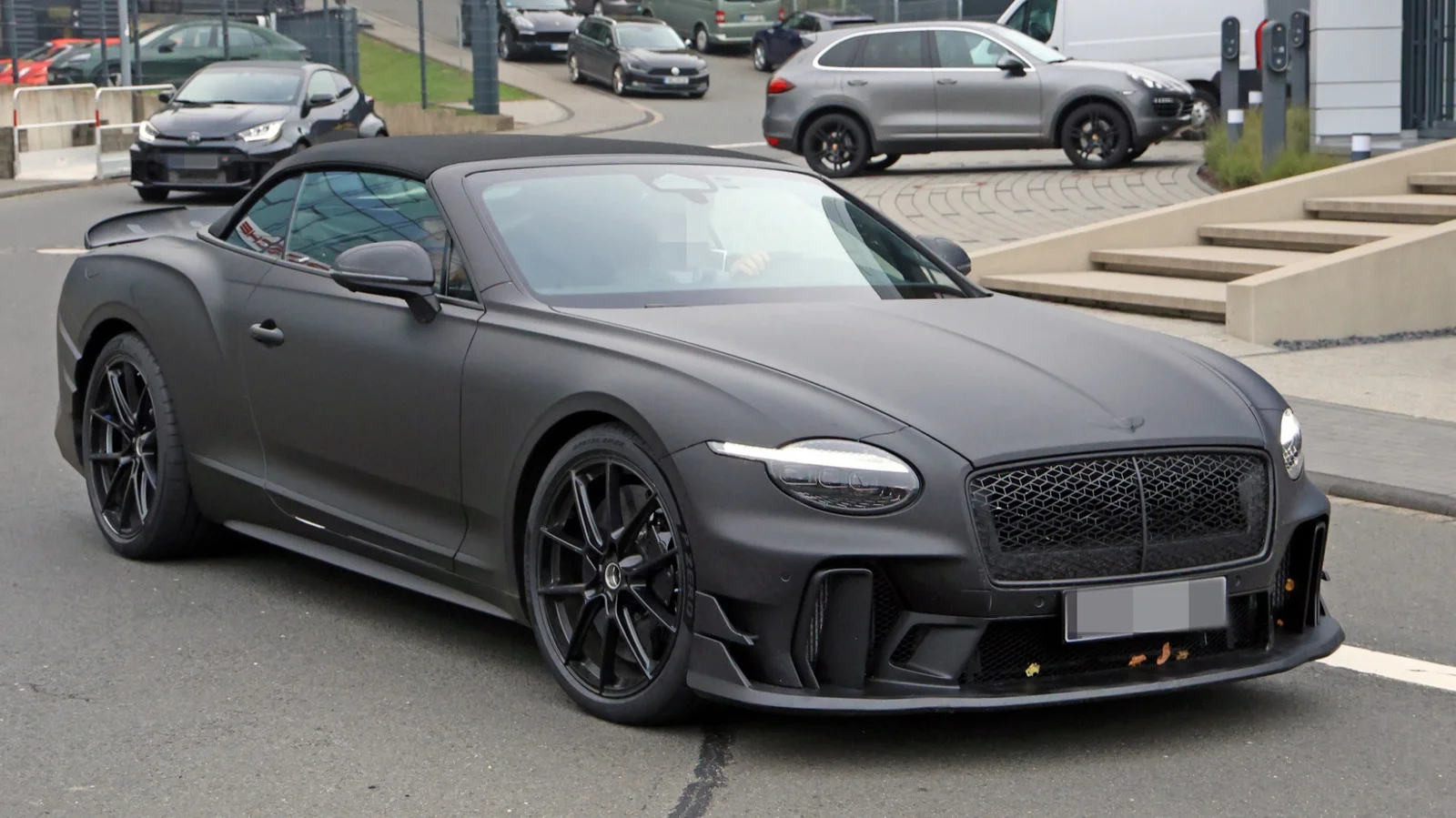
The roofless Bentley Continental Supersports appears set to trade some of the coupe’s weight advantage for open-air driving. Spy photos show the high-performance convertible testing ahead of a possible debut at the Los Angeles Auto Show this November, with the same aggressive bodywork and rear-wheel-drive focus as its fixed-roof counterpart. That combination suggests Bentley wants the convertible to carry the Supersports’ sharper character into a different kind of grand touring, even if the added structure makes it less focused on weight.
The photos show a prototype, so they don’t settle the final specification or confirm when the car will reach showrooms. Still, the visible hardware points to a model that’s being developed as more than a standard Continental GTC with its roof removed. The key question is how much of the coupe’s engineering carries over once Bentley accommodates the open-top body.
Bodywork signals a more serious GTC
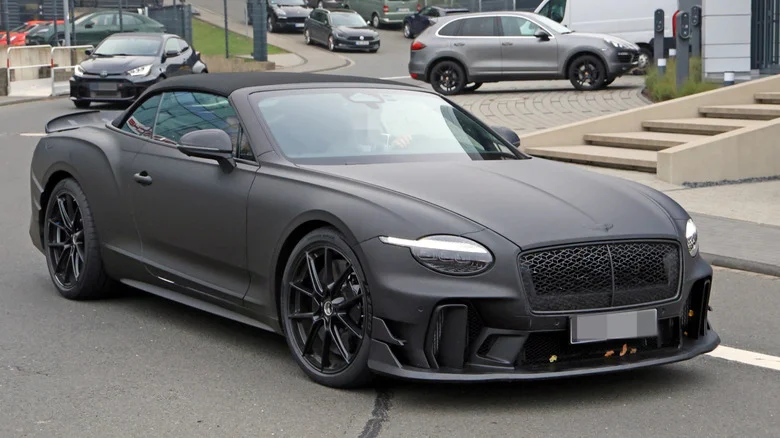
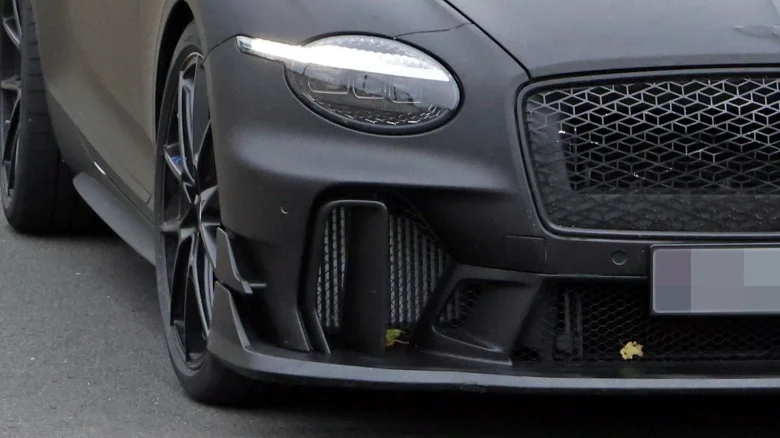
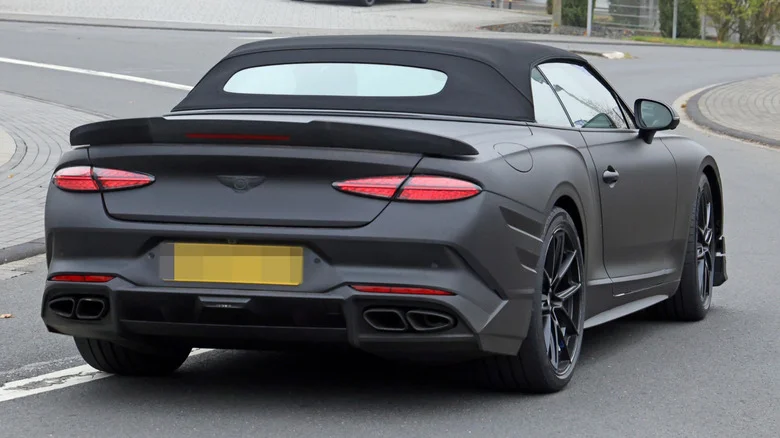
Black paint and wheels give the prototype a low-key finish, but its hardware is hard to miss. Up front are a distinctive grille, a deep splitter, large side intakes and paired dive planes. The car also sits on a wider track than a standard Continental GTC, with extended side sills, a rear diffuser and a single-piece spoiler on the trunk.
These parts give the car a broader, more purposeful stance than the regular convertible. They also suggest Bentley is trying to preserve the coupe’s visual identity across the change in roofline: the splitter and dive planes frame the front, while the wider track and diffuser make the rear-wheel-drive layout feel central to the car’s character. Spy shots can show shape and hardware, though they can’t tell us how much aerodynamic work those pieces do at speed.
 SH Proshots
Rear-wheel drive sets the Supersports apart
The coupe established a more focused formula for Bentley’s grand tourer. It drops the hybrid system, front differential and driveshafts, making it the first rear-wheel-drive Continental in the model’s 23-year history. A carbon-fiber roof and the removal of the rear seats help cut nearly 1,000 pounds (455 kg), bringing the coupe’s curb weight to just under 4,410 pounds (2,000 kg).
That weight reduction matters because the Supersports is still a large luxury car, not a lightweight sports car in the conventional sense. Removing hardware and rear seats changes the brief: Bentley has given up some of the Continental’s all-weather traction and passenger flexibility to put more emphasis on the driver. The rear-wheel-drive layout is therefore part of a wider engineering choice, not just a headline feature.
The convertible will add weight. A regular Continental GTC is 390 pounds (177 kg) heavier than the coupe, so the open-top Supersports is unlikely to match the coupe’s figure. Its reward may be a clearer soundtrack from the full-length titanium exhaust Bentley developed with Akrapovic. That’s a straightforward trade: more mass and a different body structure in return for open-air motoring and a more exposed V8 note.
Power comes from a 4.0-liter twin-turbo V8 with larger turbochargers and upgraded cylinder heads. In the coupe, it produces 657 hp (666 PS) and 590 lb-ft (800 Nm), sent to the rear wheels through an eight-speed dual-clutch transmission. The spy photos don’t confirm whether the convertible will share those specifications, but the prototype’s Supersports identity points in that direction. If you're working in this space, that distinction matters: the badge is a strong clue, but it isn’t a substitute for confirmed technical details.
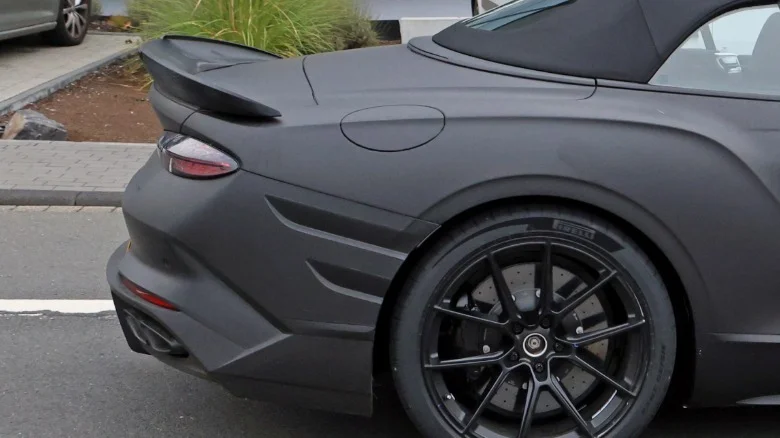 SH Proshots
More focused, and likely more expensive
The hybrid Continental models make as much as 771 hp (782 PS) and 738 lb-ft (1,000 Nm), so the Supersports gives up power in exchange for a lighter, more driver-focused setup. Bentley’s chief executive, Dr. Frank-Steffen Walliser, oversaw its conception and engineering after leading the Porsche 918 Spyder project. The comparison with Porsche’s 911 GT3 is apt: Bentley is positioning the car around handling as well as straight-line pace.
The numbers here are underwhelming only if horsepower is the sole measure. Against the hybrid Continentals, the Supersports has less output, but its reduced weight and rear-wheel-drive configuration indicate a different priority. The 911 GT3 comparison helps explain the pitch, though it doesn’t make the Bentley a direct equivalent: the Continental remains a grand tourer, shaped by comfort, size and luxury as well as handling.
That focus comes at a steep price. All 500 Supersports coupes sold quickly despite a $490,150 sticker, about $140,000 above a Continental GT Speed. Bentley may limit the convertible to a similar 500 cars, and it’s expected to cost well over $500,000. The open-top version’s appeal will hinge on whether buyers value the V8 soundtrack and sharper character enough to accept the extra weight and price.
(And this is the part most people overlook.) A convertible’s appeal can’t be judged by comparing its curb weight with the coupe alone; the experience it offers is the point of the added hardware. Even so, Bentley will need to make the distinction feel meaningful, since the buyer will be paying more while accepting less of the coupe’s weight advantage. The car’s eventual specification and price will show how the company balances those competing priorities.
What the convertible has to prove
The possible Los Angeles Auto Show debut gives the prototype a near-term public milestone, but the spy photos leave the core questions open. Bentley hasn’t confirmed the convertible’s output, curb weight, production limit or final price in the information available here. Those details will determine whether it comes across as a coherent open-top interpretation of the Supersports or mainly as a rarer, louder version of the GTC.
That said, the direction is clear: Bentley is testing a convertible with the coupe’s visual aggression and rear-drive emphasis, while accepting that a folding roof carries a weight cost. For buyers, the choice may come down to what they value more—the coupe’s lighter, more concentrated setup or the convertible’s open-air character. A compelling soundtrack helps. It won’t, by itself, settle the trade.
Discussion
Sign in to join the discussion.