BMW’s three-row iX7 is testing with a possible battery larger than 144 kWh, while a V8-powered X7 M60 is also in development.
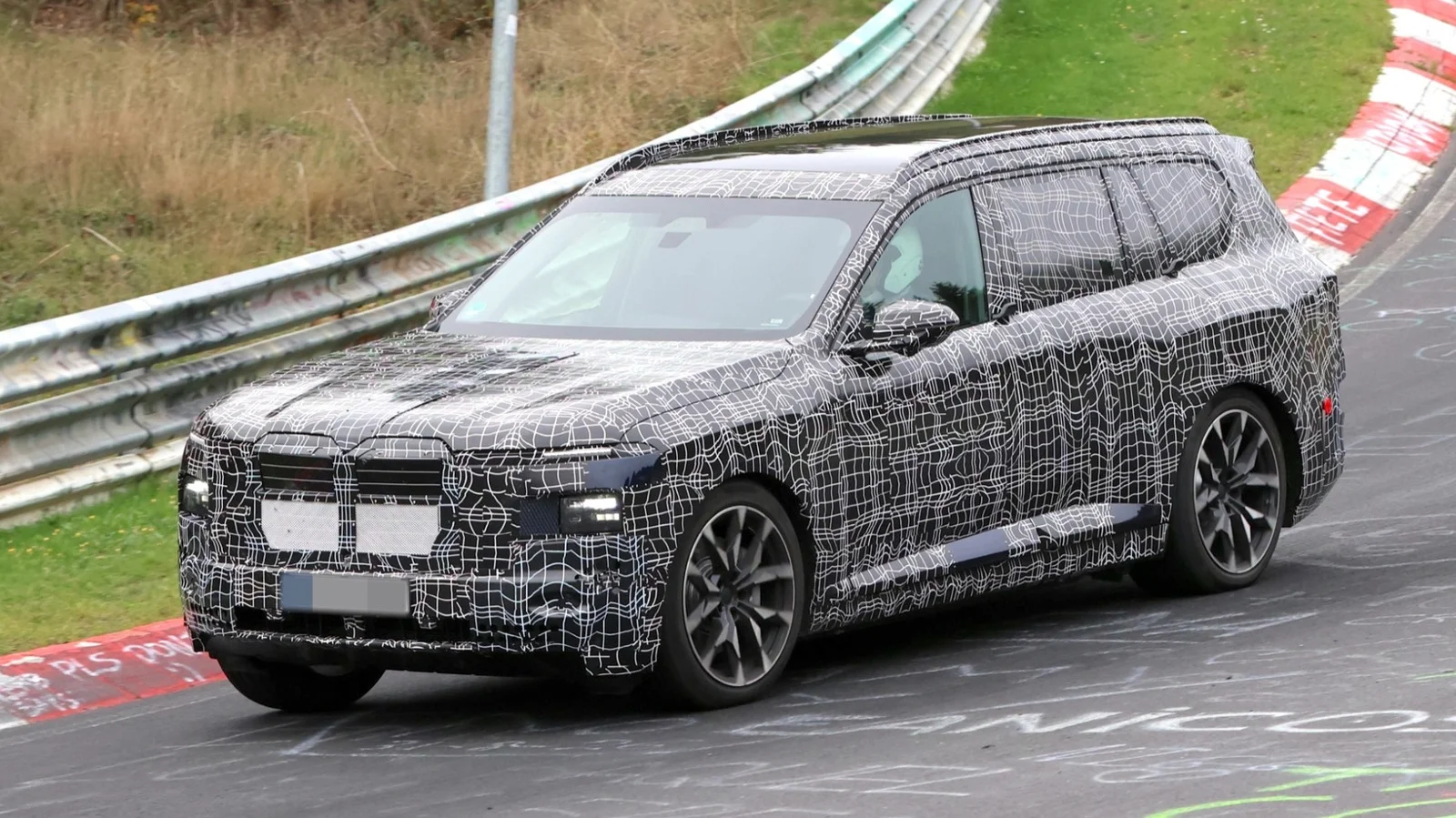
The Nürburgring sighting of BMW’s iX7 points to a two-track plan for its largest SUV: a three-row electric model built alongside an updated gasoline X7. The electric version is still in development, with a debut expected in 2027 and a U.S. sale date next fall. BMW appears to be adapting its existing platform for both powertrains while updating the design and cabin technology. That approach would let the company carry familiar X7 proportions into an electric model, while keeping a gasoline option in the same size class. The split matters because buyers considering a large luxury SUV may care as much about seating and range as they do about the powertrain.
The prototype’s laps at the 12.9-mile (20.8-kilometer) German circuit are likely part of durability and vehicle-dynamics testing. The iX7 isn’t being positioned as a track SUV; BMW puts its models through similar assessments, from the X1 to the 7 Series. A circuit like this gives engineers a controlled setting to assess how a vehicle behaves under sustained demands, though a sighting alone can’t tell us which parts of the car are being tested. The lap footage is a clue to the development process, not a preview of the iX7’s intended use.
Large battery, familiar platform
The iX7 and X7 are expected to use an updated version of BMW’s CLAR architecture, rather than the Neue Klasse platform found in the iX3, iX4 and iX5. That means the iX7 will retain the split-headlight design introduced for the 2023 X7, while adopting newer body surfaces and small powered wings at the base of the pillars in place of conventional door handles. Keeping the two SUVs on a shared architecture could help BMW maintain a closer relationship between the electric and gasoline models. It also suggests the iX7’s design will evolve from the current X7, rather than mark a clean break from it.
Staying with CLAR doesn’t rule out newer electric hardware. BMW’s cylindrical battery cells and electrical systems could support charging rates of up to 460 kW. The iX5 provides a useful reference: its 144-kWh battery is rated by BMW for an estimated 435 miles (700 kilometers) of EPA range. Those figures show the kind of capability BMW says its newer electric components can support, but they don’t establish what the larger iX7 will deliver. Charging speed and range also depend on the finished vehicle and its battery configuration, details BMW hasn’t confirmed for this model.
The iX7 is likely to be about five inches (125 millimeters) longer than the iX5, based on the difference between the previous X5 and X7. That extra length may leave room for a larger battery, though BMW hasn’t confirmed the pack size or range. It may also help accommodate the iX7’s three-row layout, where passenger space and cargo room have to coexist with the battery and electric hardware. This is more significant than it looks: in a large family SUV, a strong range estimate won’t answer every practical question if the cabin can’t meet the needs that justify the vehicle’s size.
The vehicle’s size and three-row layout make those figures central to its appeal, particularly against electric luxury SUVs such as the Range Rover Electric and Cadillac Escalade IQ. The comparison puts pressure on BMW to make the iX7 feel like a full-size luxury SUV in everyday use, not simply a large electric vehicle with an impressive battery. If you’re working in this space, you’ll know that range is only one part of the buying decision; space, charging and powertrain choice all shape the proposition. And BMW hasn’t yet supplied the specifications that would let buyers weigh those trade-offs.
BMW is expected to share motor options with the iX5. That could give at least one iX7 variant the iX5 60’s dual-motor output of 570 horsepower (578 PS). The source also anticipates higher-performance, M-badged electric versions, though BMW has yet to detail them. Sharing motors would give BMW a starting point for the range, but the iX7’s eventual output and performance remain unconfirmed. A larger, heavier vehicle may also ask more of its powertrain than a smaller SUV does.
Shared cabin technology, U.S. production
The electric and gasoline SUVs are expected to share BMW’s Panoramic iDrive interior. The setup pairs a pillar-to-pillar gauge display with a parallelogram-shaped center screen, as seen in the 2027 iX5. Carrying the same cabin concept across both X7 versions could make the models feel related even as their powertrains differ. The screen layout will be a visible part of that identity, but the available details don’t say how the controls or software will differ between the electric and gasoline SUVs.
BMW plans to build the iX7 and X7 at its Spartanburg, South Carolina, plant alongside the iX5 and X5. Producing the electric and gasoline models at the same site would bring the two branches of the large-SUV line together in one manufacturing location. That’s a useful part of the story because the iX7 isn’t being presented as a standalone experiment; BMW is planning it alongside an updated X7. The company hasn’t described what that shared production will mean for the vehicles’ specifications or availability.
The iX7 is expected to debut in 2027 and reach the market the following fall, so buyers will have to wait for confirmed range, pricing and specifications. Those details will determine whether BMW’s platform choice translates into a compelling electric alternative for people who need three rows. Until then, the battery and motor references offer a frame of possibility, not a finished product brief. The wait for specifics is part of the story.
The X7 M60 keeps a V8 in the lineup
The electric launch won’t displace gasoline power. Spy photos also show an updated X7 M60, which is expected to replace the current X7 M60i. The new model is likely to keep a revised version of BMW’s 4.4-liter S68 twin-turbo V8, currently rated at 523 horsepower and 553 pound-feet of torque. BMW’s apparent plan is to keep the large SUV’s existing performance identity available while adding an electric counterpart. That gives the lineup a broader choice of powertrains, although the details of the next M60 remain unsettled.
BMW’s M760 xDrive sedan offers a possible indication of the engine’s next output: 563 horsepower (571 PS), with torque unchanged. That sedan uses mild-hybrid assistance rather than a plug-in hybrid system, and the X7 M60 could follow a similar approach. The sedan is a reference point, not confirmation of the SUV’s final tune. The prototype’s open kidney-grille intakes and four exhaust outlets distinguish it from the iX7, whose grille is blanked off. Here’s the thing: the visible differences make the two paths easy to read, but they don’t tell us how BMW will balance their performance, price or equipment.
BMW hasn’t offered a full X7 M, and one isn’t expected with the next model. An Alpina version could sit above the M60, with a three-row luxury SUV reportedly planned for 2028. For now, the developing range suggests BMW intends to give large-SUV buyers a choice between long-range electric power and a stronger V8. That choice could matter to customers who want the space and presence of an X7 but have different preferences about charging, driving character and engine sound. BMW’s next challenge is to make each version feel suited to its role, while explaining what buyers gain from stepping up to the electric model. Until specifications arrive, the strategy is clearer than the product itself.
Discussion
Sign in to join the discussion.